
TAC Sponsor Spotlight Article – Englobe
by Eric Dyson
As communities across Canada continue to grow, the interface between urban development and provincial transportation infrastructure is becoming increasingly complex. Integrating active transportation facilities within these environments presents unique challenges related to safety, accessibility, design standards, constructability, and long-term performance.
The Pathway 17 Multi-Use Trail in Lethbridge, Alberta provides a practical example of how these challenges can be addressed through coordinated design and context-sensitive solutions. Delivered along 43rd Street South (Highway 4), the project connects 20th Avenue South and Forestry Avenue South while tying into the existing pathway network at 24th Street South. It also extends into the urban roadway network along Parkside Drive South, requiring a seamless transition between highway and urban conditions.
Through collaboration between the City of Lethbridge and Alberta Transportation and Economic Corridors, the project demonstrates how active transportation infrastructure can be successfully integrated within a provincial highway corridor while improving safety, accessibility, and overall user experience.
Addressing a Critical Safety Gap
Prior to construction, cyclists traveling through this corridor frequently relied on the shoulder of Highway 4. This placed users in close proximity to high-speed vehicular traffic, creating a safety concern for both cyclists and motorists and limiting the usability of the corridor for a broader range of users.
A primary objective of the Pathway 17 project was to provide a dedicated multi-use facility that would remove cyclists from the highway shoulder and offer a safer, more comfortable alternative.
By shifting users away from the live traffic environment and onto a separated pathway, the project significantly reduces exposure to high-speed vehicles. This separation not only improves safety outcomes, but also increases user confidence and comfort, helping to make active transportation a more viable option for daily travel within the corridor.
Working Within a Constrained Transportation Corridor
One of the defining aspects of the project was the need to work within a constrained highway corridor while balancing differing design expectations between municipal and provincial stakeholders.
The City of Lethbridge prioritized an alignment closer to the roadway to reflect a more urban condition and maintain connectivity with adjacent development. In contrast, provincial requirements emphasized setback from the highway to maintain safety and operational standards.
The final alignment was positioned outside the highway recovery zone while maintaining functional connectivity to the surrounding network. Achieving this balance required close coordination between stakeholders and highlights the importance of collaboration in shared transportation corridors.
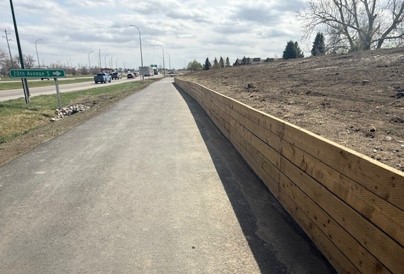
The corridor also presented significant physical constraints. The pathway alignment intersected with an existing berm, requiring regrading to accommodate the trail while maintaining existing drainage patterns and performance. Retaining walls were incorporated along sections of the pathway to manage grade constraints, minimize the project footprint, and maintain slope stability.
Existing electrical infrastructure located within the berm introduced additional complexity. A targeted hydro excavation program was implemented to safely expose utilities, reduce the risk of service disruption, and allow for precise construction within the constrained environment.
Adaptive Innovation: Recycled Material Application
The project explored sustainable material use by incorporating recycled crushed glass into the granular base for an initial section of the pathway as part of contractor methodology.
While similar approaches have been successfully implemented in controlled crushing environments, the use of on-site mixed material presented constructability challenges, particularly in achieving consistent material quality and performance.
In response, the project team adapted the approach to maintain construction quality while preserving the intent of material reuse. The remaining crushed glass material was repurposed as drainage backfill behind retaining wall structures, replacing conventional washed rock.
This adaptive approach:
- Maintained construction efficiency
- Supported sustainable material use through the successful diversion of recycled glass from the waste stream
- Reduced reliance on virgin aggregate materials by repurposing the recycled material for high performance structural backfill.
The experience highlights both the potential and limitations of recycled material applications within transportation projects and reinforces the importance of aligning methodology with site-specific conditions.
Designing for Safety, Accessibility, and Visibility
Safety and accessibility were central to the project’s design, particularly at interaction points where the pathway interfaces with roadways.
Deceleration focused design was incorporated at key locations to improve driver awareness and reduce the severity of potential conflicts between vehicles and pathway users. These treatments help create a more predictable and controlled environment for all users.
Accessibility was enhanced through the inclusion of dropped median crossings, allowing for barrier-free movement across the corridor. Tactile walking surface indicators were also installed to support visually impaired users and improve navigation at crossing locations
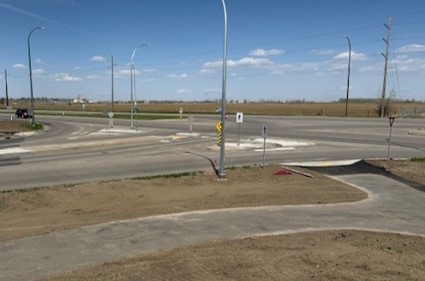
In addition to geometric and accessibility improvements, lighting enhancements were incorporated at key intersection crossings to improve visibility for both pathway users and motorists. These improvements support safer operation during low-light conditions and contribute to overall user comfort and confidence.
The Lethbridge transportation design team worked closely with Englobe East’s team on the road safety component, ensuring that both user and vehicular considerations were addressed in a coordinated manner.
A Crime Prevention Through Environmental Design (CPTED) review was completed in collaboration with local law enforcement during the design phase. This process improved sightlines, reduced areas of concealment, and enhanced both real and perceived safety along the pathway.
Maintaining Continuity Through Urban Transitions
A common challenge in pathway design occurs where trails transition into urban environments. Asphalt pathways are often replaced with standard concrete, creating both durability concerns and a visual break in the network.
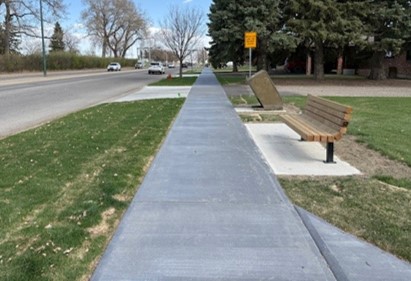
Along Parkside Drive South, the Pathway 17 project addressed this issue through the use of integrally coloured concrete matched to the appearance of asphalt. This approach maintains a consistent visual identity for the pathway while improving durability at high-stress locations such as driveway crossings, and roadway interfaces.
Bike ramp connections were also incorporated at collector roadway tie-ins, providing smooth and intuitive transitions between the pathway and on-street network. These features enhance usability for cyclists and support a more seamless connection between transportation modes.
A Coordinated and Transferable Approach
The success of the Pathway 17 Multi-Use Trail is rooted in its coordinated approach. By aligning municipal objectives with provincial requirements, the project team delivered a solution that meets the needs of both jurisdictions while improving overall corridor function.
The project demonstrates that:
- Meaningful safety improvements can be achieved by separating users from highway traffic
- Accessibility can be enhanced within corridor environments through thoughtful design
- Visibility and safety can be improved through targeted lighting and design interventions
- Continuity can be maintained across varying conditions through targeted material strategies
- Complex constraints can be addressed through practical engineering solutions.
These lessons are directly applicable to other communities were urban development interfaces with provincial transportation infrastructure.
Conclusion
The Pathway 17 Multi-Use Trail illustrates how active transportation infrastructure can be successfully integrated into a provincial highway corridor through collaboration, innovation, and a focus on user needs.
By removing cyclists from the highway shoulder, improving accessibility and visibility, and maintaining continuity across transitions, the project delivers a safer and more connected transportation network. It also provides a practical, scalable model for future projects seeking to balance the demands of urban growth and provincial transportation systems.