
TAC Sponsor Spotlight Article — Stantec
By: Andrew Harkness, P.Eng, IRP, Climate Solutions Leader, Stantec,
and Rebecca Leitschuh, AICP, Infrastructure Resilience Leader, Stantec
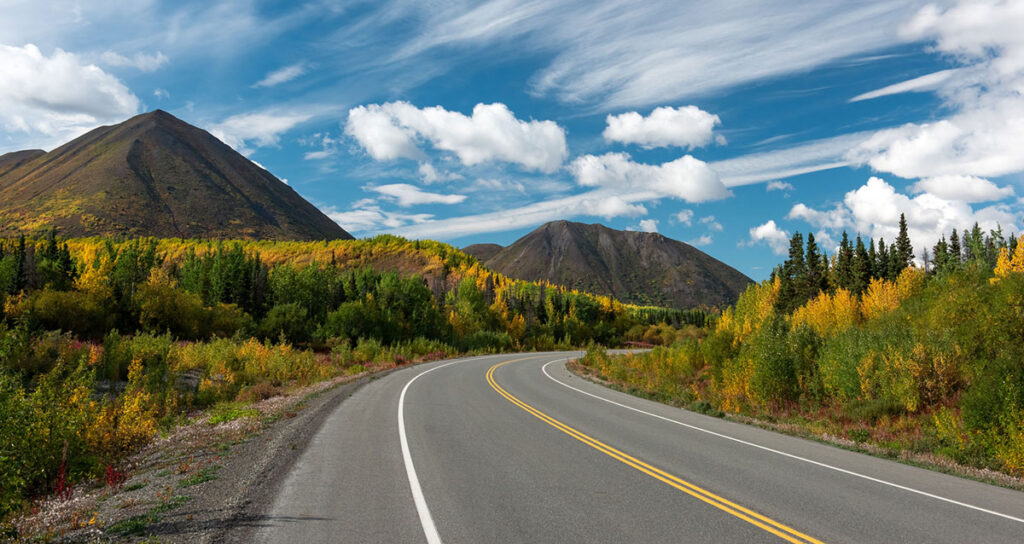
The Yukon Highways Climate Risk Assessment and Action Plan, led by Stantec Consulting Ltd., equips the Government of Yukon with an innovative plan to support the resilience of its 3,700+ kilometre highway network against climate change and geohazards. By integrating leading resilience research, a multidisciplinary team and Yukon’s Department of Highways and Public Works (HPW) have advanced Yukon’s climate action policy framework with key stakeholders. The project helps to reduce highway and economic disruptions; safeguard people, property and infrastructure; and support safe, reliable travel across 15 key corridors under current and future (2050s) climate conditions.
With Yukon warming more than twice as fast as the rest of Canada, the impacts of climate change on transportation infrastructure are an urgent concern. The Yukon Highways Climate Risk Assessment and Action Plan was developed to help the Government of Yukon address these challenges and enhance the resilience of the territory’s highway network.
Project Objectives
The overarching purpose of this project is to better position the Government of Yukon to enhance the resilience of its highway infrastructure in the face of climate change. The study identified and assessed risks based on exposure, likelihood, and consequence, and developed and prioritized adaptation measures for all moderate, high, and extreme risks across both baseline and future (2050s) time horizons. The project aligns closely with Yukon’s ongoing commitments to acting on climate change:
- 2019: The Government of Yukon declared a climate emergency, emphasizing the urgent need for climate action.
- 2020: The release of Our Clean Future, Yukon’s climate strategy, outlined action item T25, which directed the HPW to conduct a climate change study of the highway network.
- 2024: The completion of the Yukon Highways Climate Risk Assessment and Action Plan marked a critical milestone in advancing the territorial government’s climate adaptation goals.
Specific objectives that were achieved through the project included:
- Designing a robust methodological approach to characterize the uncertainty of climate change impacts on highway infrastructure — including 3,700 km of roadways, 130 bridge structures, and 7,100 drainage culverts.
- Integrating existing research and best practices for adapting highway infrastructure to the effects of climate change.
- Characterizing seven geohazards (thermokarst, Aufeis, flooding, fluvial processes, landslides, avalanches, wildfire) by assessing their type, distribution, and nature and preparing associated mapping for each highway corridor.
- Conducting a high-level climate risk assessment and developing a comprehensive action plan to mitigate the highest-priority risks.
- Informing future policy directions, budget priorities, and engineering standards to better support resilient road infrastructure design and maintenance.
Outcomes and the Project’s Anticipated Legacy
The project’s action plan categorized 16 overarching adaptation measures into five implementation categories (governance, further study, monitoring, operations and maintenance, capital works), with implementation staging based on priority, risk reduction and barriers. Adaptation pathways were developed to allow for flexibility, aligning resilience strategies with evolving conditions and infrastructure goals.
This is a first-of-its-kind effort for Yukon (and rather unique in Canada) and integrates leading research on infrastructure resilience into real-world infrastructure development. By balancing a territorial-scale study with targeted, infrastructure component-level solutions, the project provides a transferable framework for other jurisdictions and lessons learned.
Relevance to Other Jurisdictions
Addressing the physical impacts of climate change on infrastructure and the built environment is a concern that is increasingly relevant across Canada. Clients, owners, and communities are recognizing the growing urgency of advancing climate adaptation and resilience as the intensity and frequency of climate-related events increase. The methods used in this risk assessment and findings can be adapted to suit individual project, client, or community needs.
Lessons Learned
1. Engineering Leadership
The work highlights the engineer’s role in advancing positive societal change. By breaking new ground in infrastructure resilience and climate adaptation, it demonstrates how the profession continues to evolve. A multidisciplinary team of engineers, environmental specialists, climate scientists, and risk assessment experts collaborated closely with the Yukon government and stakeholders to advance innovative approaches to infrastructure design and operation.
2. Interdisciplinary Problem Solving
A cross‑disciplinary approach integrated expertise from geoscience, climate science, risk assessment, and engineering to build a comprehensive understanding of climate and geohazard risks to Yukon’s highway infrastructure. Geoscience and climate science informed the identification and evaluation of regional hazards, while highway, bridge, and water resources engineering expertise supported model cases illustrating interactions between infrastructure and geohazards. These model cases were integrated with risk management practices to assess hazard exposure, likelihood, and consequences. Together, this collaborative approach addressed complex engineering challenges and demonstrated the value of integrated, multi‑disciplinary solutions for advancing climate resilience.
3. Cross Pollination Beyond Engineering
This project pushes the boundaries of traditional engineering by integrating concepts and methods from diverse disciplines, including industrial ecology, safety science, and planning/policy.
- Material Flow Analysis: Originating in industrial ecology, this method estimates long-term material needs for highway construction and maintenance, optimizing stockpiles and reducing carbon emissions. It includes assessing current material quantities, forecasting future needs, identifying surpluses or shortages, sourcing alternatives, and ensuring materials are ready for repairs.
- Safe-to-Fail Design: Borrowed from safety science, safe-to-fail design departs from conventional infrastructure design, which focuses on preventing failure at all costs. Instead, it anticipates and prepares for failure, seeking to minimize the consequences of failure. This paradigm opens new possibilities, such as:
- Designing highway sections to fail in a controlled fashion during flooding, protecting other areas and reducing costs.
- Designing roads to act as dams, reducing the potential of catastrophic downstream flooding.
- Adaptation Pathways: As climate change increasingly affects infrastructure, proactive planning is needed to address a range of future climate conditions while retaining flexibility to adapt. Adaptation pathways — drawn from planning and policy practice — offer a structured way to engage owners, communities, and stakeholders. By supporting collaboration at multiple scales, they help guide the development of resilient, sustainable infrastructure in an uncertain future.
4. Focus on What Matters Most
The complexity of climate risk assessments, in a region as large and varied as Yukon, may shift focus toward the technical details — enhancing data collection and analysis, refining methodologies, and better integrating stakeholder feedback. While these aspects are important, the core purpose of the risk assessment and action plan is clear: protecting what matters most to Yukoners.
This means safeguarding — or even reimagining — the highways that connect communities, drive economic opportunities, and sustain cultural and social bonds. When we prioritize what matters most, the project signals the deeper purpose of resilience: not just addressing risks but also nurturing the infrastructure systems that keep Yukon’s communities strong, connected, and prepared to thrive now and into the future.
Learn more about Climate Change Mitigation & Adaptation Capabilities at Stantec.
For further information, please reach out to Andrew Harkness and Rebecca Leitschuh.