
TAC Sponsor Spotlight Article — Bentley Systems
The Union Station Rail Corridor (USRC) is not merely a set of tracks; it is the central artery of Canada’s busiest transportation hub. Serving over 300,000 commuters daily, it is an irreplaceable piece of infrastructure for the Greater Toronto Area. Any interruption to its service has immediate and widespread consequences.
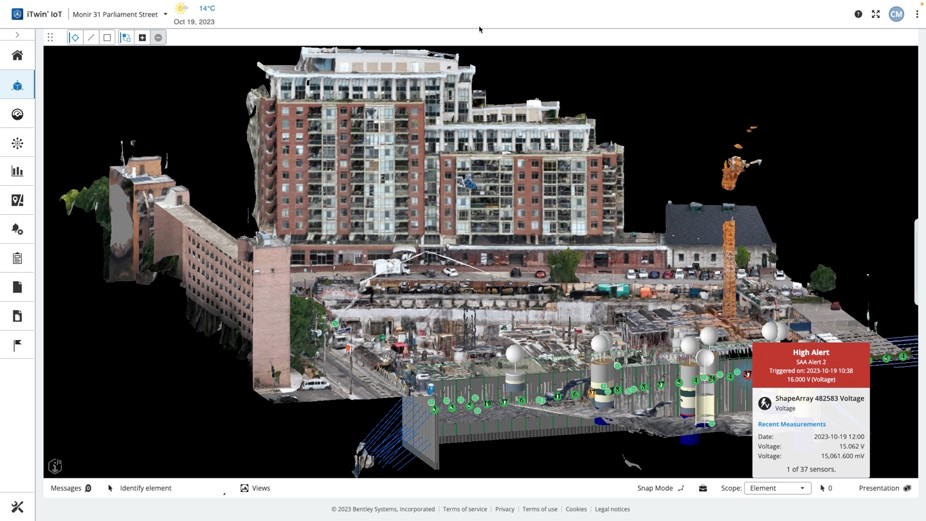
Image courtesy of Monir Precision Monitoring
When Lanterra Developments planned the construction of a 41-story condominium tower, the No. 31, on a site immediately adjacent to this corridor, the project’s primary challenge became clear: how to execute a major deep excavation without threatening the operational integrity of this vital rail network.
Client Needs: A Hidden Challenge beneath a Beloved Neighbourhood
Most people wandering through Toronto’s Distillery District have no idea what lies beneath their feet. Between the red-brick buildings, cobblestone streets, and bustling cafés, it’s easy to forget this picturesque neighbourhood sits on land that was once underwater. Over the centuries, the land was reclaimed from Lake Ontario by extending the shoreline with a mix of garbage, construction debris, and industrial fill.
But those unstable ground conditions make building in the area especially complex. So, when a new luxury high-rise broke ground at 31 Parliament Street, it wasn’t just another addition to the skyline. It was a test of precision engineering, teamwork, and digital monitoring ingenuity.
Challenges: A Boutique Firm with a Big Responsibility
Crews and specialists had to contend with difficult soil conditions shaped by years of human-made fill and industrial activity, all while protecting the 6.4 kilometres of track, 14 rails, and a web of switches belonging to the neighbouring Union Station Rail Corridor. Disruptions weren’t an option.
“Any shift in the ground could translate to movement in the rails,” explained Samantha Ford, president and general manager of Monir Precision Monitoring, the boutique firm brought in to oversee the project’s critical monitoring operations. “We had to make sure that didn’t happen.”
A VIA Rail passenger train and several green GO Transit commuter trains are parked on parallel tracks in a rail yard, reflecting Toronto rail protection efforts and advancements in rail safety innovation.
“Keeping the commuter corridor open throughout the project was crucial,” Ford added. “It was about more than protecting infrastructure. It was about protecting people’s daily lives.”
Monir Precision Monitoring isn’t a multinational conglomerate. Based in Mississauga, this firm specializes in geotechnical and structural monitoring for complex construction environments. But what they lack in size, they make up for in agility, innovation, and deep expertise.
“If I had to explain my job to a 10-year-old, I’d say I come up with the cool ideas to solve tricky problems, and my team makes them happen,” Ford laughed.
On the No. 31 project, Monir was tasked with monitoring both the excavation shoring and the adjacent rail corridor for any signs of displacement. But this wasn’t just about installing a few monitoring sensors and calling it a day. It required continuous, real-time data collection — and the ability to interpret that data quickly enough to keep the city’s busiest rail line running safely.
Solutions: Smart Monitoring for a High-Stakes Site
To meet the demands of the site, Monir deployed a comprehensive monitoring system that combined traditional instrumentation with advanced digital tools. The setup included:
- In-place inclinometers (IPIs) to measure lateral ground movement
- Automated total stations (ATS) to track precise shifts in excavation walls and nearby structures
- Vibrating wire piezometers to monitor groundwater pressure
- Rail monitoring prisms installed directly on the tracks to detect vertical or lateral movement
All this data was streamed into Bentley’s iTwin IoT software, where it was integrated into a live digital twin of the site. But iTwin IoT did more than just consolidate the data — it turned the data into actionable insights. Real-time alerts notified engineers the moment readings crossed predefined thresholds, while custom dashboards gave project managers an at-a-glance summary of site health.
The platform allowed Monir to set trigger levels specific to each instrument and customize notifications based on severity, location, or stakeholder. This meant the right people received the right information at the right time, enabling faster, more informed decision-making in a highly dynamic environment.
Beyond data collection and alerting, the digital twin also became a powerful communication tool, bringing together diverse teams around a single, real-time view of the site.
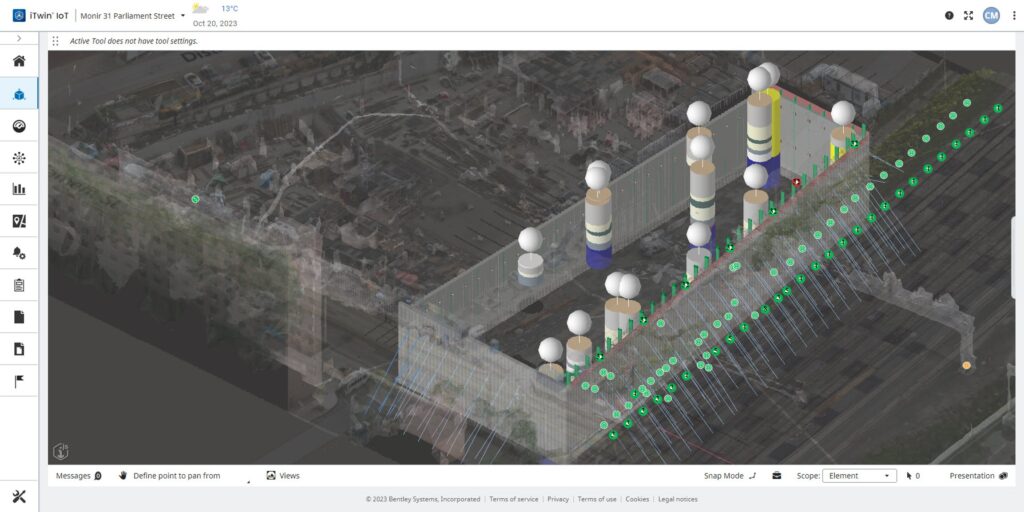
Image courtesy of Monir Precision Monitoring
Bridging Communication Gaps with Digital Twins
Urban construction projects often bring together a wide range of stakeholders — from engineers and project managers to city officials and transit authorities. Miscommunication or delays in sharing information can quickly lead to costly or dangerous outcomes.
Monir’s use of a visualized digital twin created a single, accessible source of truth. Stakeholders could toggle between live sensor readings, drone imagery, and construction models to better understand how the excavation was affecting surrounding infrastructure. Ford said that, before adopting this approach, it felt like “trying to monitor a site through binoculars from a distance.” With the digital twin, “everyone’s looking at the same thing,” which simplified complexity and made it easier to see what was happening underground in real time. “It brought real life to the project,” Ford reflected. “Suddenly, it wasn’t just numbers on a spreadsheet—it was something people could see and act on together.”
Key Outcomes:
Monir Precision Monitoring’s innovative approach didn’t just safeguard the Union Station Rail Corridor during construction, it delivered measurable, lasting benefits. By integrating Bentley’s iTwin IoT into their monitoring strategy, Monir achieved a 40% increase in operational efficiency, saved more than 3,000 hours in on-site assessments, and helped shave six months off the overall project timeline.
These efficiencies translated into substantial cost savings, with the project reportedly saving around USD 1 million. More importantly, continuous, real-time monitoring ensured the critical rail infrastructure remained stable and operational throughout excavation, maintaining uninterrupted service for over 300,000 daily commuters.
Key Community Benefits: A Model for Smarter, Safer Cities
“The Bentley software and services deployed on this project gave us peace of mind in the results, speed of delivery, and reliability of critical monitoring information for early detection of any issues that may arise,” said Ford.
For Ford and her team, safety was personal. “A lot of our workers have friends and family at home who want them to come back safe,” she said. “And hundreds of thousands of commuters rely on those trains every day. Keeping both groups protected was a top priority for us.”
The success at 31 Parliament Street is more than a single project win, it’s proof of what’s possible when advanced digital tools, real-time data, and committed teams come together. For Ford, it’s a glimpse into the future of urban infrastructure management.
“We’d love to see entire cities running on digital twins someday,” she said. “It’s not just about individual projects. It’s about protecting communities, improving operations, and making smarter decisions for the places we live and work.”
In fast-growing cities like Toronto, where history meets progress on every corner, projects like this demonstrate that even the most complex challenges can be overcome with the right technology, the right strategy, and the right people.
Want to dive deeper into the technology behind this project?
Learn more about iTwin IoT and how it can help take your infrastructure monitoring to the next level.