
TAC Sponsor Spotlight Article — Solmax
Introduction
Across Canada, our infrastructure faces mounting challenges: heavier traffic loads, aging systems, and extreme weather events. Roads, bridges, and waterways are under pressure from forces that traditional construction methods struggle to withstand. The question is no longer whether these challenges exist, but rather how will we respond. At Solmax, our focus is on practical, research-driven solutions that help engineers and communities build resilient infrastructure, while reducing the environmental impact.
The Reality: Roads Under Pressure
Changing climates add new stresses to roads already burdened by frost heave and poor ground conditions — challenges that have long shaped Canada’s infrastructure. When roads fail prematurely, the ripple effect is significant: higher life-cycle costs, traffic disruptions, and the depletion of high-quality aggregate, a resource that is increasingly expensive and scarce.
Smarter Materials, Stronger Outcomes
Advances in geosynthetics have changed how we approach these problems. These engineered materials do more than separate layers; they reinforce, manage moisture, and protect against erosion. By integrating these functions into our infrastructure, engineers can extend service life, reduce maintenance, and minimize environmental impact. Let’s look at how this works in practice.
Practical Solutions in Action
Managing Moisture and Extending Pavement Life: MIRAFI® H2Ri
The reconstruction of 116th Street, an arterial road in Grande Prairie, Alberta, illustrates the power of advanced geosynthetics. After a major rebuild in 2011, the southbound lanes began showing severe cracking and rutting within seven years. This timeframe was far short of the intended 25-year design life of 6.0 million ESAL’s (Equivalent Single Axle Loads). Investigations revealed frost-susceptible, high-plasticity clay subgrade and moisture-related distress as key contributors.
Rather than repeat the same approach, the city adopted a high-modulus moisture management geosynthetic — MIRAFI® H2Ri. This material combines reinforcement strength with wicking fibers that actively move water out of the pavement structure and subgrade soil. By removing and/or redistributing moisture, MIRAFI H2Ri mitigates frost heave, thaw weakening, and differential movement in fine-grained soils.
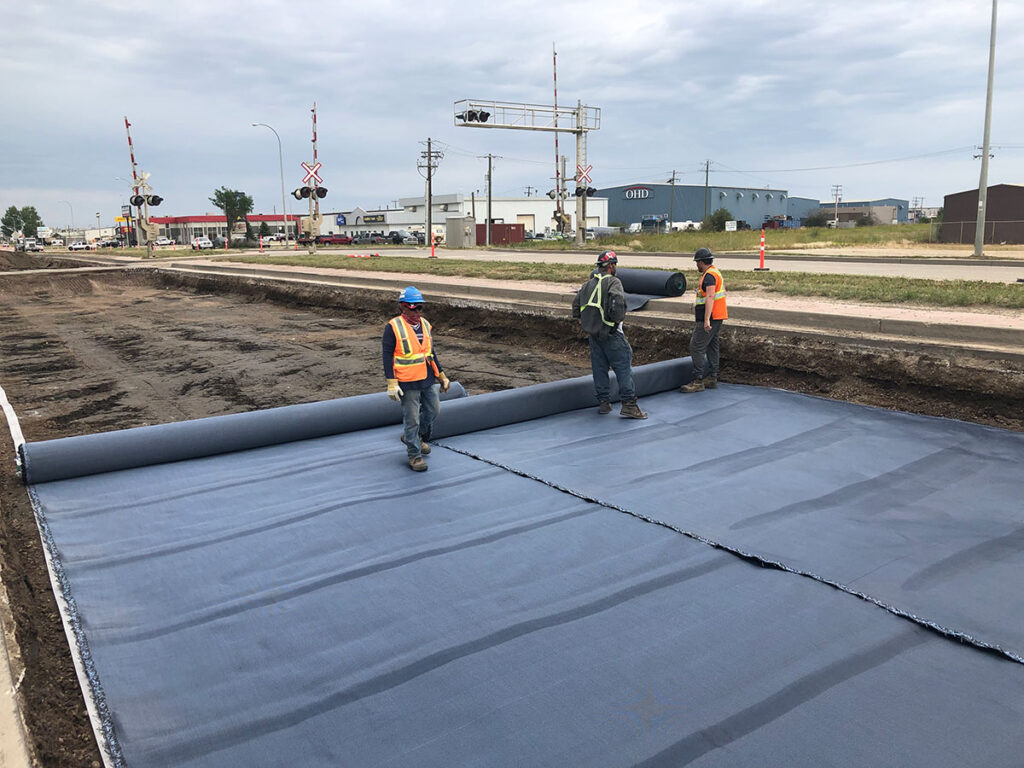
H2Ri Moisture Management Geosynthetic deployed over weak, high plasticity soils
The results speak volumes. The redesigned section targeted 9 million ESALs (Equivalent Single Axle Loads) in the weakest anticipated ground conditions. With MIRAFI H2Ri, a projected life of up to 26 million ESALs under favourable ground conditions was achieved. Use of MIRAFI H2Ri also eliminated the need for costly moisture conditioning of the subgrade and expensive subcuts, reducing construction time and risk. Three years after installation, the roadway shows no signs of distress, a dramatic improvement over the previous design.
Protecting Critical Infrastructure: PROPEX® Pyramat
Lloydminster, Alberta, has faced major flood events in 2016, 2018, and 2023, highlighting how changing climate patterns are stressing municipal infrastructure. These events prompted the City to upgrade its drainage network, starting with the Northwest Drainage Channel — a critical link that previously lacked the capacity to manage a 10-year storm event, resulting in roadway flooding and business disruption.
The redesign expanded the channel from 1.5 m to 5 m wide and incorporated long-term erosion protection using PROPEX® Pyramat® High Performance Turf Reinforcement Mats (HPTRM). Pyramat provides hydraulic resistance, prevents soil loss, and promotes rapid vegetation growth, creating a natural system capable of withstanding flows from the 100-year flood event.
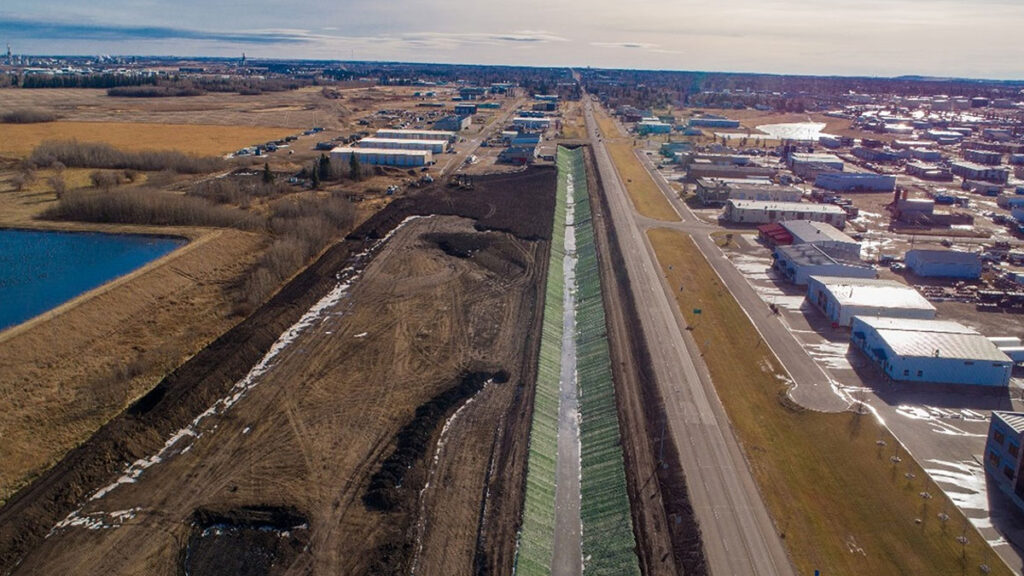
Northwest Drainage Pyramat 75 installation prior to vegetation establishment
The benefits were compelling. Pyramat generated only 3.9 kg of CO₂ per square metre, compared to 38 kg for traditional riprap and 60 kg for articulating concrete blocks — a huge reduction in carbon footprint. Installation costs showed similar advantages: Pyramat delivered over 80% savings compared to rock or concrete. Beyond cost and carbon reductions, the vegetated system improved water quality, significantly lowering soluble metals and total suspended solids (TSS) downstream compared to upstream levels.
Safeguarding Waterways: PROPEX Scourlok®
Water is both a life source and a force of destruction. PROPEX Scourlok® addresses this by providing an engineered bank stabilization system designed to resist extreme hydraulic stresses and protect shorelines while promoting vegetation. This diverse solution was developed for erosion control applications that need scour protection but can also be utilized as a vegetated gravity wall system to resist sliding and overturning.
Its modular design can easily be contoured to accommodate a range of landscapes. This approach replaces hard armour with a nature-based solution that works with nature, not against it. In addition to providing a vegetated solution that helps improve soil health, PROPEX Scourlok enhances water quality by maximizing the removal of pollutants and sediments.
Innovative Geosynthetic Solutions for REM’s Engineered Berm
The Réseau express métropolitain (REM) light metro project in Montréal, led by NouvLR, required a robust foundation to support its elevated tracks while ensuring long-term stability and environmental integration. Solmax provided two key geosynthetic solutions that played a pivotal role in achieving these objectives.
To reinforce the engineered berm supporting the REM alignment, Miragrid® XT geogrid was installed. This high-performance geogrid delivers exceptional tensile strength and soil interaction, enabling the berm to withstand dynamic loads from the light metro system. Its use minimized settlement risks and enhanced structural integrity, ensuring safe and reliable operations for decades to come.
Complementing this, Solmax’s PROPEX Pyramat turf reinforcement mat (TRM) was applied to stabilize the berm’s slopes. The TRM effectively controls erosion, protects against surface runoff, and promotes rapid vegetation growth. This approach not only secures the slopes but also integrates the infrastructure into its natural surroundings, creating a vegetated corridor that is both sustainable and resilient against future wear and tear.
Together, these solutions demonstrate how advanced geosynthetics can meet the dual challenge of engineering performance and environmental stewardship in major transportation projects.
Why It Matters: Lower Impact, Longer Life
Every kilometre of roadway or shoreline protected with geosynthetics represents a reduction in carbon footprint. These solutions minimize excavation, reduce raw material use, and extend infrastructure life — cutting emissions over the asset’s lifecycle. They also support natural systems, from vegetation growth to habitat preservation, aligning infrastructure development with environmental responsibility.
The Road Ahead
Canada’s infrastructure challenges won’t disappear — but our approach can evolve. By embracing proven technologies like moisture management geosynthetics and engineered erosion control systems, we can build roads, slopes, and waterways that stand the test of time. Solmax is committed to partnering with engineers, municipalities, and agencies to deliver solutions that work — today and for decades to come.
Durable, efficient, and environmentally responsible solutions aren’t optional, they’re essential. The future of infrastructure depends on choices we make now. Let’s choose smarter.