
TAC Sponsor Spotlight Article—Colas
Introduction
In Canada, pavement construction and rehabilitation decisions have traditionally prioritized cost and performance, with environmental impacts often considered secondary or overlooked. This is largely due to limited awareness, lack of incentives, and the absence of standardized methods for evaluating environmental impacts. As sustainability becomes increasingly important, Environmental Product Declarations (EPDs) are emerging as essential tools to provide transparent, comparable information about the environmental performance of products over their life cycle. EPDs are based on Life Cycle Assessment (LCA), an internationally recognized methodology, and can guide stakeholders—including consumers, engineers, and policymakers—in making informed decisions about sustainable products and services.
Life Cycle Assessment (LCA) Methodology
LCA is a comprehensive tool used to assess the potential environmental impacts of a product from resource extraction to end-of-life, including production, transportation, and use. According to ISO 14040 and 14044 standards, LCA consists of four phases:
- Goal and Scope Definition: Establishes the purpose, system boundaries, and context for the study.
- Inventory Analysis: Collects data on material and energy flows for all processes involved.
- Impact Assessment: Transforms inventory data into impact scores across categories such as climate change, toxicity, water depletion, and acidification.
- Interpretation: Tests the robustness of results through uncertainty and sensitivity analysis, leading to conclusions and recommendations.
Each LCA is based on a functional unit, ensuring that comparisons between products are valid and context specific.
What Are Environmental Product Declarations (EPDs)?
EPDs, also known as Type III environmental declarations (ISO 14025), are standardized documents derived from LCA results. They provide detailed information on resource consumption, greenhouse gas (GHG) emissions, waste generation, and other environmental impacts. EPDs function similarly to nutrition labels on food products, offering transparent data that helps customers select products that best meet their sustainability needs. The objective of EPDs is to use credible, precise data to stimulate demand for and availability of products with reduced environmental impacts, supporting businesses in demonstrating sustainability.
Product Category Rules (PCRs)
To develop EPDs, Product Category Rules (PCRs) are required. PCRs are sets of specific rules, requirements, and guidelines for developing Type III environmental declarations for a given product category. They ensure consistency in data quality, system boundaries, and impact assessment methods, enabling fair comparisons between products. PCRs must include:
- Product category definition and description
- Goal and scope (system boundaries, data quality requirements)
- Inventory analysis (data collection, calculation procedures)
- Impact categories and inventory data categories
- Materials and substances to be declared
- Instructions for producing required data
- Information on excluded stages (if any)
- Period of validity (typically 5 years)
PCRs must be reviewed internally or externally, and third-party review is required for business-to-consumer communication. There are four categories of EPDs: industry-wide, product-specific, supply chain-specific, and facility-specific. For asphalt mixes, product-specific and plant-specific EPDs are most appropriate.
EPDs for Asphalt Materials in Canada
EPDs for asphalt materials exist but are not widespread in Canada. Several factors contribute to this:
- Lack of Government Regulations: No national legislation mandates EPDs for construction products, reducing incentives for manufacturers.
- Low Demand: Limited awareness and understanding among stakeholders about EPD benefits and processes.
- Cost and Complexity: Developing EPDs requires significant resources and specialized expertise.
- Data Availability: Reliable primary and secondary data are needed, which may not be readily accessible.
Despite these challenges, increasing demand for sustainable construction products and improved understanding of EPDs are expected to boost their availability in Canada.
Programs and Initiatives
In the United States, some states require EPDs for construction materials through regulations like “Buy Clean” policies, which leverage public purchasing power to encourage lower-carbon options. Canada is developing similar initiatives, such as the Greening Government Fund, the Made-in-Ontario Environment Plan, Quebec’s Bill 12, and the Toronto Green Standard, which mandates net-zero buildings after 2030. EPDs for concrete are more common in Canada, supported by programs like LEED, which incentivize the use of materials with EPDs.
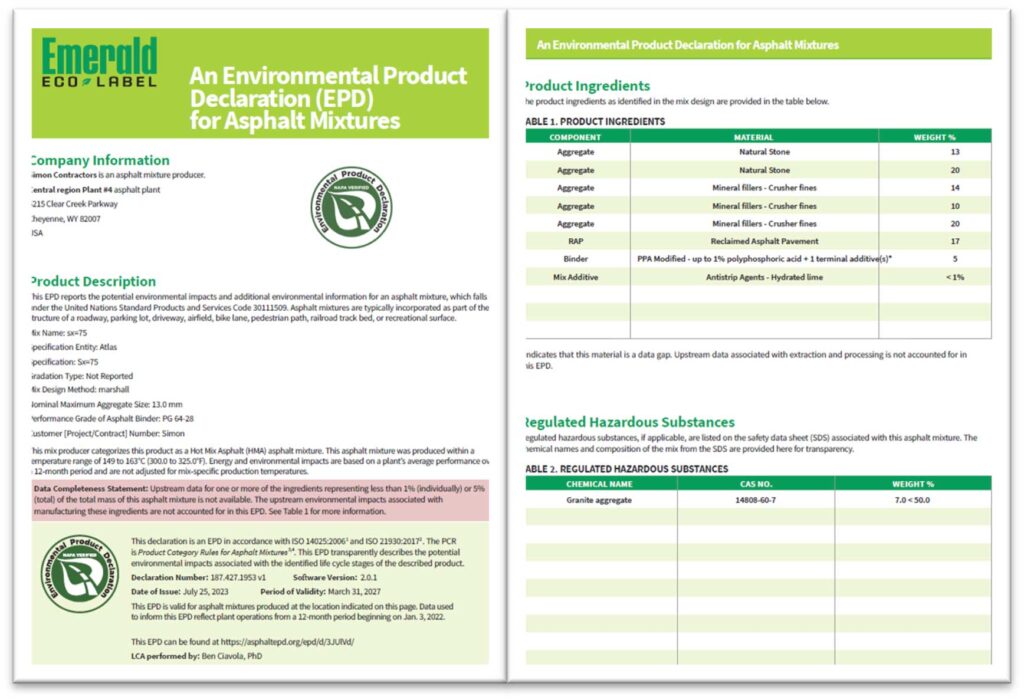
The National Asphalt Pavement Association (NAPA) has developed the Emerald Eco-Label EPD program for asphalt materials, providing a web-based tool for producers to develop plant-specific and mix-specific EPDs. However, this tool currently does not support Canadian plants, though future updates may address this limitation.
Examples and Analysis of Asphalt Mix EPDs
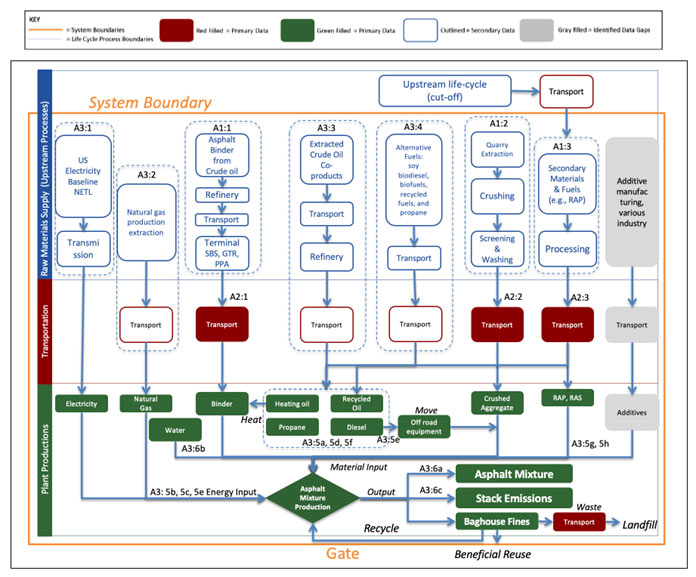
EPDs for asphalt mixes are concise documents containing precise information as required by PCRs. Analysis of 30 randomly selected EPDs revealed significant variations in GHG emissions, with raw materials (A1) contributing 46%, production (A3) 38%, and transport (A2) 17%. The greatest variation was observed in transport, highlighting the need for plant-specific and product-specific EPDs. Over time, data from the USA shows a downward trend in GHG emissions per ton of asphalt mix, attributed to tactics like increased use of Reclaimed Asphalt Pavement (RAP).
Environmental Impact of Asphalt Mixes
Canada’s extensive road network, mostly paved with asphalt, requires ongoing rehabilitation, which involves producing, transporting, and laying down new mixes. These activities consume large quantities of materials and energy, generating emissions and other environmental impacts. LCA methods, such as ReCIPE 2016, categorize impacts into midpoints (e.g., climate change, human toxicity) and endpoints (e.g., damage to human health). Climate change is the most commonly used category for assessing pavement products.
GHG emissions from asphalt pavement construction primarily involve carbon dioxide (CO2), methane (CH4), and nitrous oxide (N2O), with respective global warming potentials of 1, 28, and 273 over a 100-year horizon. In 2021, the USA emitted 6,340 Mt CO2 eq, and Canada 680 Mt CO2 eq. Asphalt production accounts for about 0.3% of total emissions in the USA, but transportation and laydown add to this figure. Comparatively, concrete production has higher GHG emissions per tonne, mainly due to cement production.
Carbon Reduction Strategies
Canada’s Paris Agreement commitments aim to reduce GHG emissions to 30% below 2005 levels by 2030 and achieve net-zero emissions by 2050. For the asphalt industry, achieving net-zero requires increased use of RAP, longer-lasting pavements, net-zero supply chains, and decarbonized electricity. The Ontario Asphalt Pavement Council and NAPA’s Road Forward plan emphasize these strategies.
Carbon Reduction Potential in Project Development
Sustainability assessment systems like LEED and ENVISION promote upfront carbon reduction. The ENVISION framework outlines four approaches:
- Build Nothing: Maximize carbon reduction by determining that no new construction or renovation is needed.
- Build Less: Optimize existing assets or reduce project scope to minimize new material use.
- Build Clever: Select low-carbon techniques and solutions during design to optimize the carbon footprint.
- Build Efficiently: Use low-carbon construction methods, minimize material waste and transport, maximize recycling and reuse.
These approaches are relevant for all types of transportation infrastructure, including streets, highways, airstrips, and heavy-duty pavements.
Application to Bituminous Pavements
Advanced pavement structural design methods (e.g., MEPDG, PMED, FAARFIELD, ALIZE) enable optimization of pavement thickness and composition, reducing costs and carbon footprint. Accurate input data and thorough subgrade analysis are essential for maximizing benefits. Advanced design tools allow comparison of equivalent pavement structures, assessing overall carbon footprint rather than just material impacts. Carbon assessment tools integrate recognized carbon values, including EPDs, to estimate and compare solutions.
Techniques to Reduce Asphalt Mix Carbon Footprint
Several strategies can reduce the carbon footprint of asphalt mixes:
- Increase Use of Recycled Materials (RAP): Reduces virgin bitumen and aggregate needs, lowering GHG emissions.
- Use Bio-Binders and Carbon-Sequestering Aggregates: Partial replacement of bitumen with bio-sourced binders (e.g., lignin, pig manure) can reduce emissions, though allocation rules and biogenic carbon storage must be considered.
- Reduce Burner Fuel Consumption: Lowering moisture content in aggregates and RAP reduces energy use and emissions.
- Increase Use of Warm, Half-Warm, and Cold Processes: Lower production temperatures reduce GHG emissions, especially when combined with RAP recycling.
- Use Local Suppliers: Shorter transport distances for raw materials decrease the carbon footprint.
Life Cycle Assessment Tools
While cradle-to-gate EPDs (A1-A3) quantify specific environmental impacts, broader assessments (A1-A5 or full life cycle) are needed for rigorous comparisons. Specialized software (e.g., SIMAPRO, OneClickLCA, SEVE) can assess the entire life cycle, though some are complex and intended for specialists. SEVE, developed by the French Road Federation, is user-friendly and compares environmental solutions for road construction using quantitative and qualitative indicators.
Case Studies
Three case studies illustrate the importance of considering the full life cycle:
- A25 in Montreal: Ultra-thin asphalt concrete pavement (UTACP) had a 15% higher carbon footprint within A1-A3 but 39% lower within A1-A5 due to reduced thickness compared to typical shave and pave operations with a dense graded asphalt (DGA).
- Cold In-Situ Recycling in Ontario: This technique reduced GHG emissions by 44% compared to traditional remove-and-replace methods.
- 30-Year Comparison of Rehabilitation Techniques: Cold in-place recycling resulted in 18% lower GHG emissions over 30 years compared to mill-and-fill scenarios.

Conclusion
In Canada, pavement material and technique selection has focused on cost and performance, with environmental considerations often neglected. EPDs, grounded in LCA, provide a standardized method to quantify environmental impacts, guiding stakeholders toward more sustainable choices. The development and adoption of EPDs for asphalt mixes can drive manufacturers to improve product sustainability, support Canada’s carbon-neutral goals, and foster innovation in road construction. Strategies such as increased recycling, use of bio-binders, process optimization, and life cycle assessment tools are essential for reducing the carbon footprint of pavement materials and achieving long-term sustainability.
This article is a synthesis of an article presented in the Proceedings of the 2023 Canadian Technical Asphalt Association (CTAA).
Carter A, Levasseur A, Croteau JM, Groshenny V. “Development of Environmental Product Declarations (EPDs) for Pavement Materials in Canada”, Proceedings, Canadian Technical Asphalt Association, 68, 429-452 (2023)