
TAC Sponsor Spotlight Article — KGS Group
By Craig Rowbotham, P.Eng., Transportation Department Head
How do you accommodate future traffic growth with today’s budget? That question was at the heart of the Grand Coulee Access Road Intersection Improvement Project.
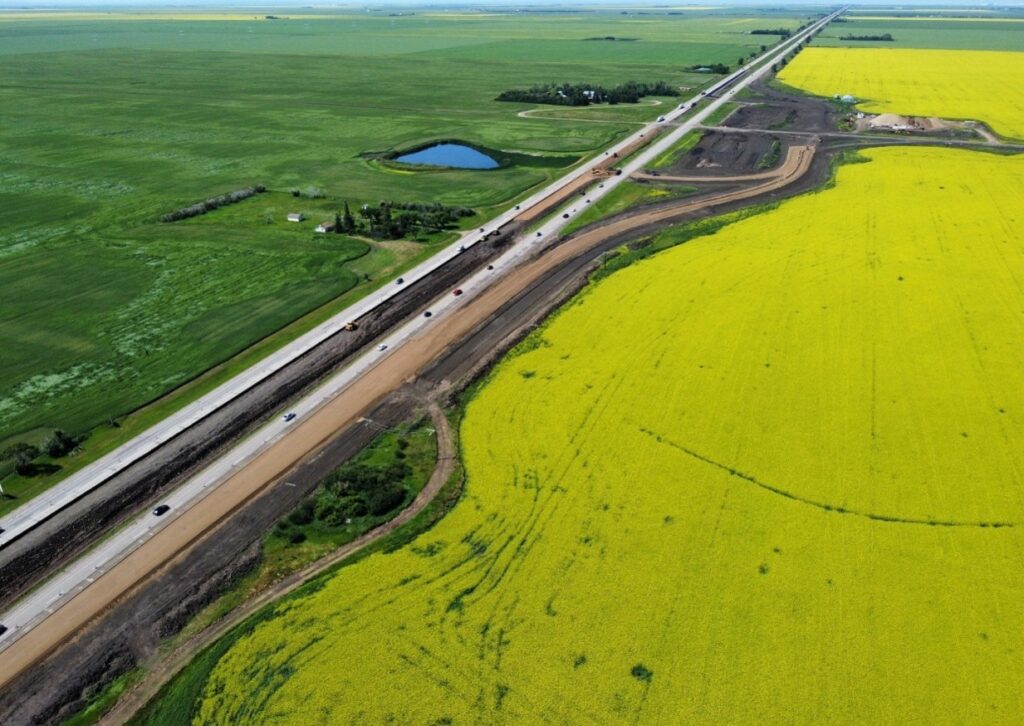
Located approximately 6.5 km west of Regina, the intersection of Highway 1 and Grand Coulee Access Road serves a growing mix of residential, commercial, and regional traffic. Planned development in the surrounding area was expected to generate substantial increases in traffic demand, raising concerns about the long-term adequacy of the existing intersection.
While future traffic projections indicated that improvements would eventually be required, forecast volumes had not yet reached the thresholds typically used to justify a grade-separated interchange. The Saskatchewan Ministry of Highways therefore faced a common transportation planning challenge: identifying a solution that could improve safety and operations, accommodate future growth, and preserve flexibility for eventual interchange construction without incurring the significant cost of grade separation today.
The result is one of Saskatchewan’s most innovative at-grade highway intersection designs and a solution that may have application at other high-growth rural corridors. The Offset Left concept relocates major left-turn movements away from the primary highway crossing and processes them through a directional ramp and roundabout system, reducing direct conflict points while maintaining highway operating speed.
Evaluation of the Alternatives
The project began as an exploration of intersection concepts capable of delivering improved performance while avoiding the cost and complexity of a conventional interchange.
A grade-separated interchange was recognized as the ultimate long-term solution, offering the highest operational performance and safety benefits. However, its cost and supporting infrastructure requirements could not be justified based on current traffic demands.
Several at-grade alternatives were therefore evaluated, each offering distinct advantages and limitations:
- Directional island configurations, which restricted certain turning movements and required speed reductions on Highway 1.
- Median storage concepts, which increased conflict points and were less compatible with future interchange development.
- Restricted Crossing U-Turn (RCUT) designs, which required speed reductions and introduced additional merging and weaving movements.
- Maintaining the existing intersection, which would not adequately address future traffic growth or emerging safety concerns.
The evaluation focused on safety, operational performance, constructability, cost, and compatibility with future corridor improvements.
The Preferred Alternative: Offset Left
The preferred solution was a roundabout-based intersection incorporating offset left-turn movements, directional ramps, acceleration and deceleration lanes, and a single-lane three-leg roundabout with a 50 m inscribed diameter.
Among the concepts evaluated, the offset left configuration provided the greatest ability to accommodate projected traffic growth while maintaining the highway’s 110 km/h operating speed. Equally important, the design could be integrated into a future interchange configuration should traffic volumes eventually warrant grade separation.
The concept delivers many of the operational benefits typically associated with an interchange while remaining entirely at grade.
By separating and redistributing major turning movements, the design substantially reduces conflict points and simplifies driver decision-making. The resulting configuration reduces vehicle conflict points from 42 to 16, improves sight distance for turning vehicles, and minimizes high-risk crossing conflicts.
How the Intersection Operates
Unlike a conventional rural highway intersection, the Grand Coulee design distributes traffic movements through a coordinated system of ramps and a roundabout.
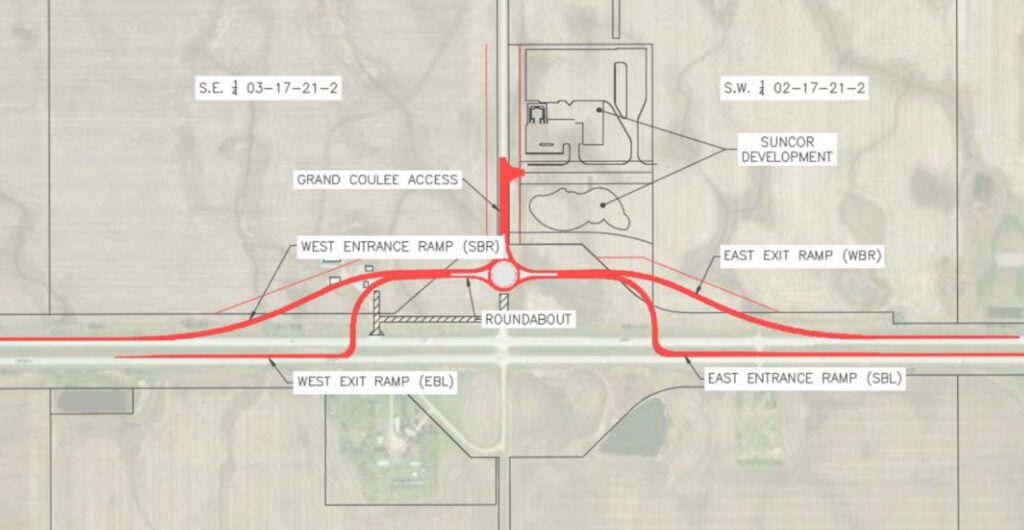
Motorists travelling between Highway 1 and Grand Coulee or adjacent commercial developments access the intersection through directional ramp connections and a three-leg roundabout. Left-turn movements, traditionally among the highest-risk manoeuvres at rural high-speed intersections, are offset from the main intersection and controlled through the roundabout system.
Acceleration and deceleration lanes further separate turning traffic from highway through traffic, reducing speed differentials and improving overall traffic operations.
For drivers, the system transforms what would otherwise be a complex crossing manoeuvre into a sequence of simpler and more intuitive decisions.
Accommodating Future Growth
A defining feature of the design is its ability to accommodate future development while avoiding premature investment in grade separation.
During functional planning, the preferred alternative was evaluated under a range of projected residential and commercial growth scenarios. Analysis confirmed that the configuration could accommodate significant increases in traffic demand while maintaining acceptable operational performance.
This approach reflects a challenge faced by transportation agencies across Canada. Growth often occurs incrementally, whereas major infrastructure investments require substantial upfront capital. As a result, agencies must balance today’s needs with tomorrow’s demands while ensuring prudent stewardship of public funds.
The Grand Coulee solution provides that balance by delivering near-term operational improvements while preserving the option for future interchange construction.
Challenges
Several site-specific challenges were addressed during design and construction.
- Accommodating large vehicles like 41-metre double turnpikes and farm equipment conflicted with the roundabout design’s fastest path targets.
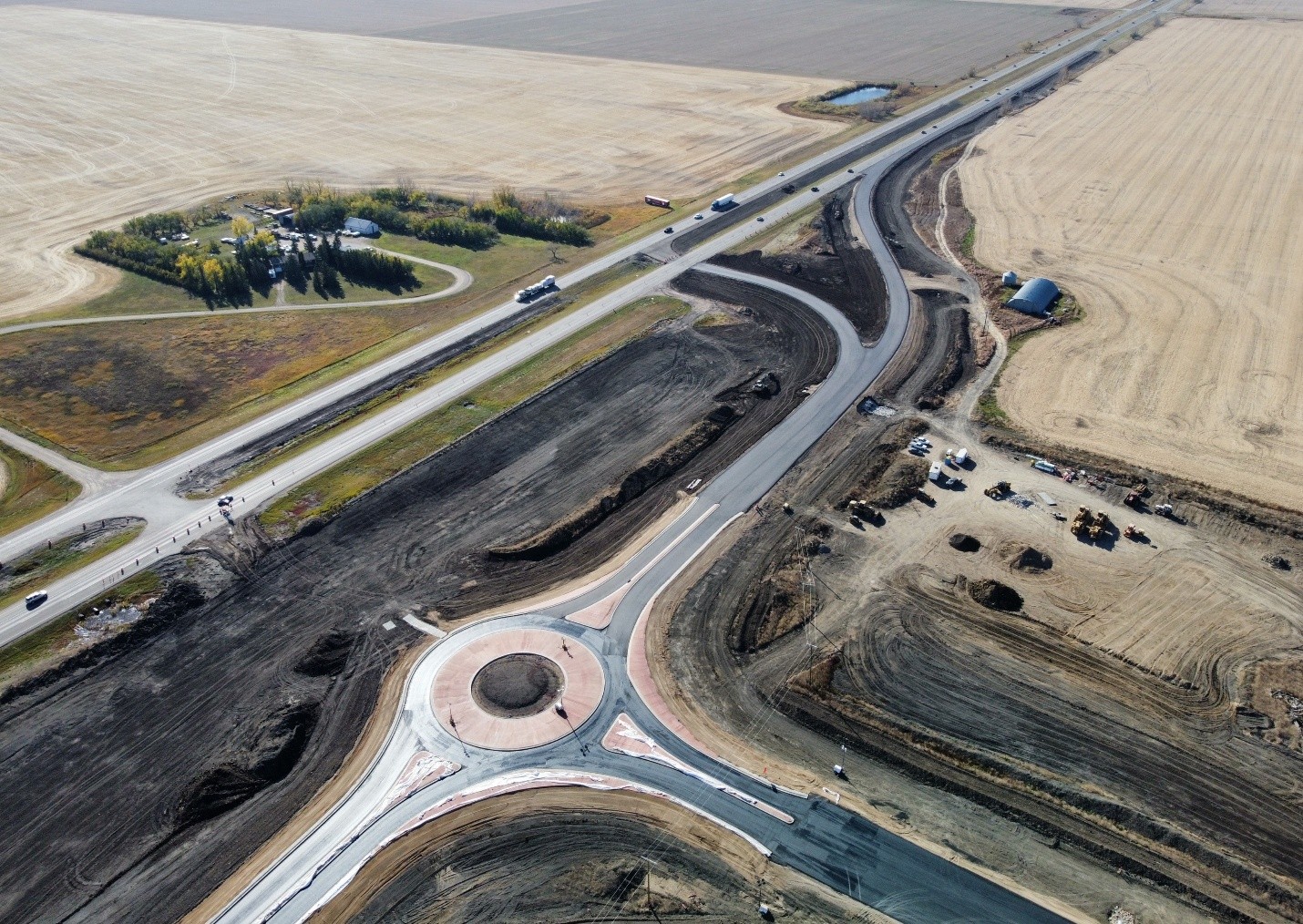
- Careful consideration was required to maintain traffic operations. Along Highway 1, construction included four acceleration and deceleration lanes. A temporary detour was constructed to travel around the roundabout installation.
- The corridor’s relatively flat topography created drainage constraints, with existing culvert elevations and hydraulic requirements influencing roadway grading and drainage design.
- Geotechnical investigations identified weak, highly plastic clay subgrade soils with significant swell potential, requiring careful consideration in pavement design and earthworks planning.
Lessons Learned
The Grand Coulee Access Road Intersection Improvement Project demonstrates that innovation does not always mean building something larger or more expensive. In many cases, the most elegant solution is the one that balances safety, operational performance, constructability, cost, and long-term flexibility.
Rather than building an interchange before it is needed, this at-grade solution delivers meaningful safety and operational benefits while managing public investment responsibly. The result is an intersection that improves safety and mobility today while positioning the corridor for tomorrow’s transportation demands.
For transportation professionals facing similar challenges, the question may not be whether a full interchange is eventually required but whether a smarter solution can safely bridge the gap.